
My Story
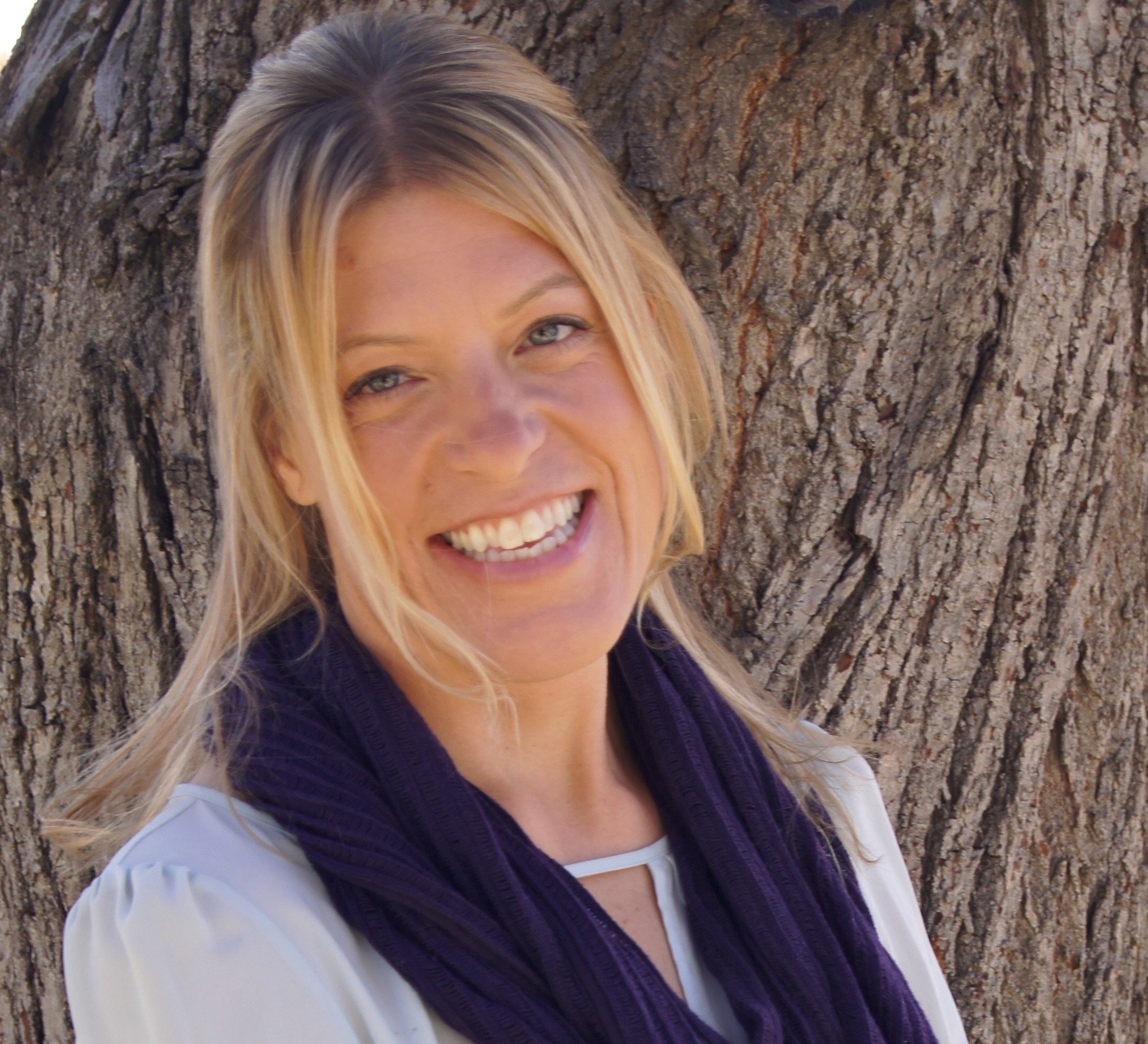
Hi, I'm Dr. Sarah Long — a trauma-specialized psychologist in Evergreen, Colorado. I work with trauma, eating disorders, grief, and loss — including the kind that doesn't always get named: major life transitions, identity shifts, the losses that don't come with a roadmap.
The people I work with tend to carry things quietly. Often alone, with more going on inside than anyone around them realizes.
Mountain athletes and their families — navigating trauma, catastrophic injury, and the losses that come with life in big terrain. Military and service families, including spouses and adult children who absorb what the service member brings home — and whose own experience is rarely the one anyone thinks to ask about. People navigating transitions or grief that changed who they are.
How I Got Here
The people I'm most drawn to work with are the ones whose stories I recognize.
Where It Started
I grew up in the English countryside, outside Cambridge, where my father was stationed with a USAF fighter squadron. Woods, fields, stone walls older than anything I'd ever see in America. It felt like magic lived there. My father was carrying wounds from two tours in Vietnam that none of us had words for yet — but in those years, in that landscape, something else was also present. I had a sense that the world was bigger than what hurt, and that I wasn’t alone out there in the fields and woods.
Then we moved back to the States. Suburbs of DC — no fields, minimal woods, mostly concrete, no sense that something larger was present in the landscape. Something went quiet in me that took a long time to find again. And yet — military family means adaptable by necessity. I got good at landing somewhere unfamiliar and finding my footing. I've been doing that ever since.
Where I Found Home
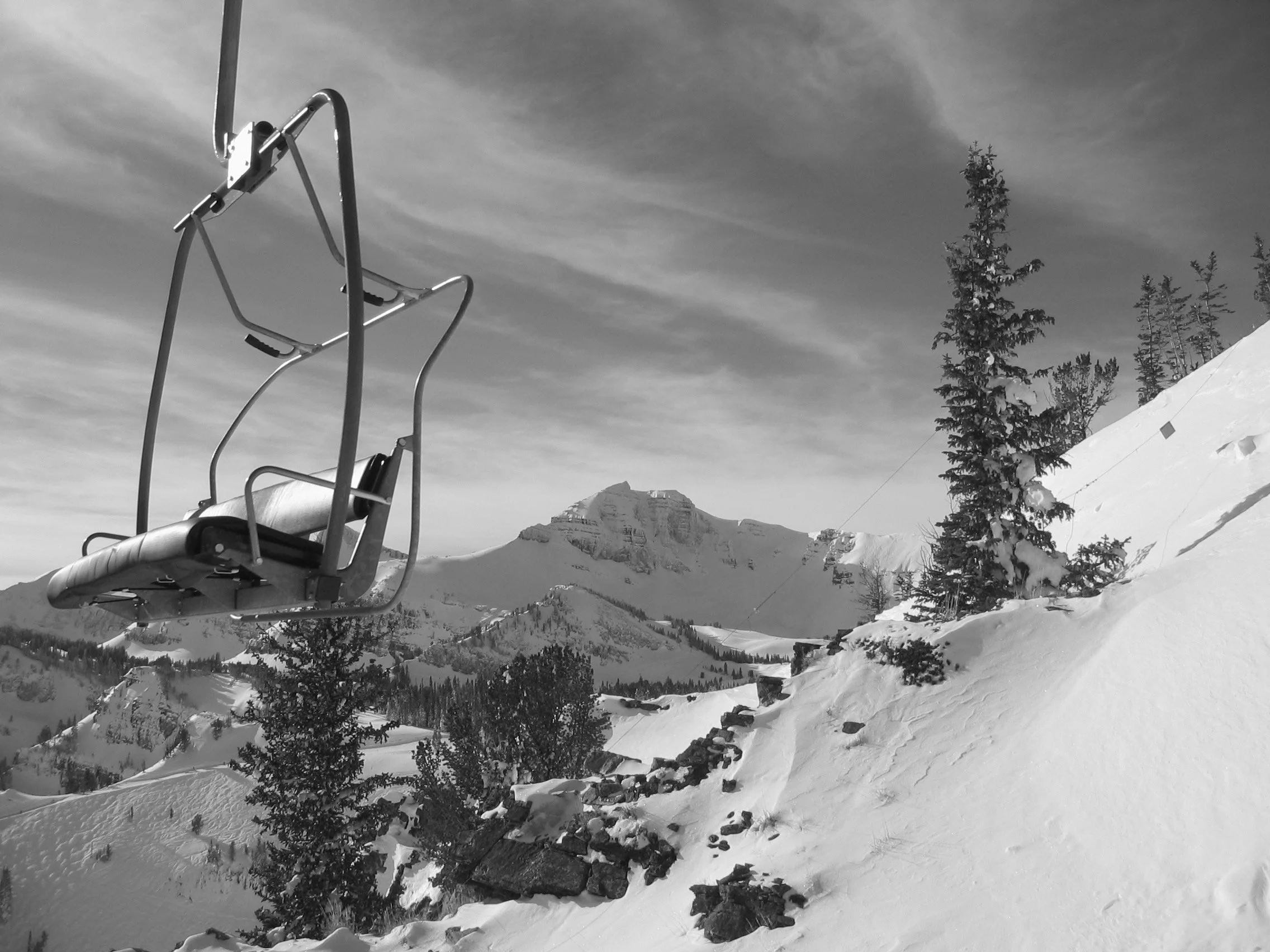
After college, I found my way to Jackson, Wyoming. And everything shifted. The mountains, the community of people who had chosen wildness deliberately — I felt, for the first time since England, like I was somewhere I was supposed to be. I became a snowboard instructor, a competitive big mountain snowboarder, and a wildland firefighter on the Bridger-Teton helicopter rappel crew. The mountains gave me a nervous system that doesn’t rattle easily, a real belief that people can come through very hard things, and the ability to sit with intensity, including my own, without needing it to resolve.
‘What it actually means to hold hope for someone who cannot hold it for themselves.’
As a snowboard coach, I watched some of the athletes quietly struggling with things I recognized from my own adolescence — my own history of an eating disorder, the gap between what was happening internally and what anyone around them could see. Jackson back then had almost no resources for them. Around the same time, a wildfire my crew was on in Montana blew up when the winds shifted and we had to run. Standing in a field watching the forest we'd just been in go up in flames, I knew I was ready for something different. In 2006, those two things together sent me to Bastyr University in Seattle, for an integrative master's in clinical psychology and nutrition.
Loss and Learning

In 2012, I left Jackson in the aftermath of a loss. Several years earlier, someone I loved, and had created a life with, sustained a severe traumatic brain injury in the mountains. Miraculously, he lived, but the person I knew was not there anymore. I stayed, carrying something I didn't yet have words for. Eventually, heartbroken and unmoored, I left for Denver — for the doctoral program in clinical psychology at the University of Denver.
I arrived in Denver carrying grief and trauma, even if I couldn't yet see all of it clearly. And I arrived curious — genuinely eager to understand more about trauma, about how people heal, about what was actually happening in the spirit and nervous systems of the people I was sitting with. The doctoral program was partly an escape from the version of my life that no longer existed.
The doctoral program built on what Bastyr had started — the integrated framework of body and psyche, now deepened by formal clinical training and years of sitting with people carrying trauma in genuine pain. I also found, during those years, that psychological assessment could be something more than testing — a careful, collaborative process that treats evaluation as therapeutic rather than something done to a person. That approach has stayed with me.
Across nearly two decades — before the doctorate, during it, and since — I've worked the full spectrum of eating disorder and trauma care, including several years at ACUTE Center, a medical stabilization unit for life-threatening anorexia. Those years taught me something no training could: what it actually means to hold hope for someone who cannot hold it for themselves. EMDR came early, in the Jackson private practice years. IFS more recently — the language of parts, of protective systems, of what lives underneath the presenting problem.
Below Where Words Go: Healing with Psychedelics
Over time, I kept hitting a ceiling with some clients, especially those who had done years of meaningful therapy and were still stuck. There was a depth that conventional approaches couldn’t reach. The therapy wasn’t wrong. Some experiences just aren’t reachable through talking.
I didn't just observe this in clients. I lived it. The grief I carried after leaving Jackson was hard and messy — and even with years of my own therapy, some of it stayed lodged somewhere below the surface. I was living a full, meaningful life. And something still hadn't moved. I’ve seen the medicines reach what nothing else could, with clients and in my own healing.
Since 2022, I've been doing ketamine-assisted psychotherapy at The Catalyst Center — working with severe PTSD, treatment-resistant trauma, severe and enduring eating disorders. Sitting with those clients has been as formative as anything I learned in a training room. I've also completed approximately 100 hours of advanced experiential training with senior medicine facilitators, and have sat with clients in expanded states outside of that training as well. Both have deepened my understanding of what these medicines can reach and what they require of the person holding the container.
The mountain athletes, the military families, the people carrying losses that don't have clean edges —
I’ve lived some of this myself. I don’t have it all figured out, but I know what it’s like from the inside.
Wondering if we’d be a good fit?
What I Know About Healing
Every person I've worked with — in two decades of clinical practice, in the most acute settings, in the deepest psychedelic work — carries something I've come to trust completely: an innate capacity to heal. I’ve watched it come back in people who had stopped believing it was there.
My job is not to fix you. It's to help create the conditions where that capacity can do what it already knows how to do.
That means all of you gets a seat at the table — your nervous system, your history, your relationships, your grief, your sense of meaning, whatever spiritual dimension matters to you or doesn't. The bio-psycho-social-spiritual framework isn't a philosophy I adopted. It's what I've found to be true, over and over, in practice.
It also means I'm not interested in shortcuts. Intensity without integration doesn't hold. A session that cracks something open and then gets left there isn't healing — it's just an opening. What gets metabolized over time, in the days and weeks and months after, is where lasting change lives. That matters as much to me as anything that happens in the room.
Healing rarely moves in a straight line. It almost never looks the way you expected. What I can offer is to stay with you through it, without an agenda for how it should go.
What Grounds Me
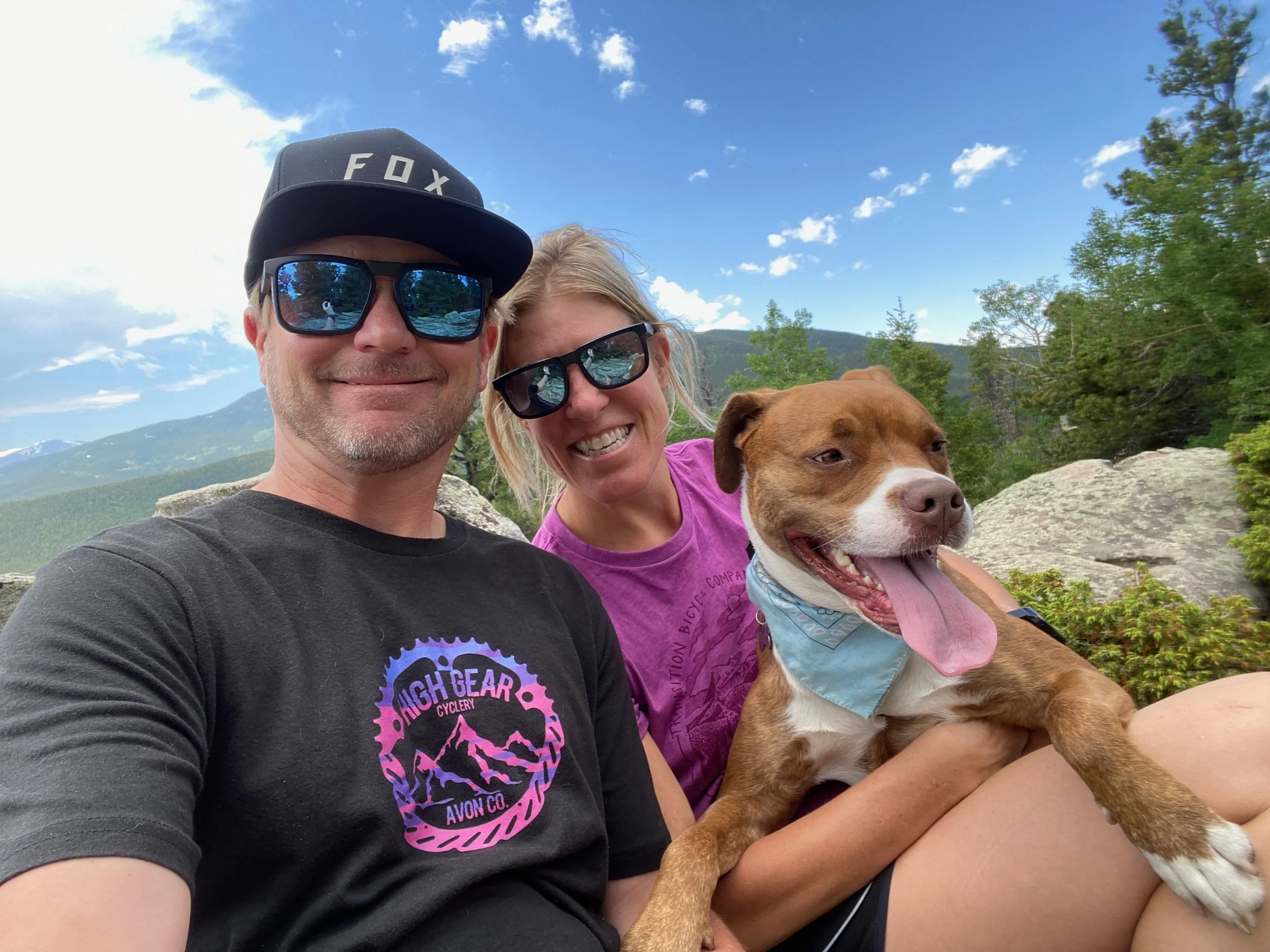
The mountains are still where I go when I need to think. My bike, my favorite tree, the ocean when I can get to it — nature has been the one constant across every chapter of my life, from the English countryside to Jackson to the Pacific Northwest to the Colorado mountains. It's where I come back to myself. Every time.
I'm held by community — colleagues who do this work alongside me, friends who know this terrain personally, the mountain communities in Colorado, Jackson, and the Pacific Northwest that will always feel like home. And every day by Trip and our pup Tia, who remind me that hard seasons do pass and the light comes back.
And I'm held by something I can't fully explain — a relationship with the unseen that started in the fields and woods of England and has never really left. It shows up in the work and outside of it — on the trail, in the cards, in the stars, in session, as a sense of something larger at work.
Education, Certifications, and Training
-
Post-doctoral Fellowship: ACUTE Center for Eating Disorders at Denver Health Medical Center, 2017-2018
Psy.D., Clinical Psychology, University of Denver, Graduate School of Professional Psychology, Denver, CO, 2017
Masters of Science, Clinical Health Psychology and Nutrition, Bastyr University, Seattle, WA, 2009
-
Certified Psychedelic Assisted Therapy Provider, Integrative Psychiatry Institute, Completed 2022
Formerly Certified Eating Disorder Specialist- International Association of Eating Disorder Professionals, 2018 – 2023
-
Plant Medicine and the Spiritual Path: Insights, Healing and Liberation, Spring Washam
Stepping Stones – IFS 4-month training, Internal Family Systems Counseling Association, 2024
Advanced Experiential Training with Senior Medicine Facilitators, 2025 — approximately 100 hours
Psychedelics and Eating Disorders, 2024
Internal Family Systems (IFS) and Psychedelic Therapy, 2023
Psychedelic Science Conference, Multidisciplinary Association for Psychedelic Studies – MAPS, 2023
EMDR with Eating Disorders: Breaking the Cycle, 2021
EMDR Basic Training Levels 1 & 2, 50-hours EMDRIA Approved Certificate Training, 2011
If something here resonates, I'd love to connect.
I offer a free 20-minute consultation to talk through what you're interested in and whether we might be a good fit. Reach out at hello@drsarahlong.com or use the contact form below.